
Size exclusion Chromatography (also known as gel filtration Chromatography)

Introduction Size Exclusion Chromatography
Principle
Component
Applications
Advantages
Challenges
Introduction
Size exclusion chromatography (SEC), also known as gel filtration chromatography or gel permeation chromatography, is a chromatographic technique used for the separation and purification of molecules based on their size.
Principle:-
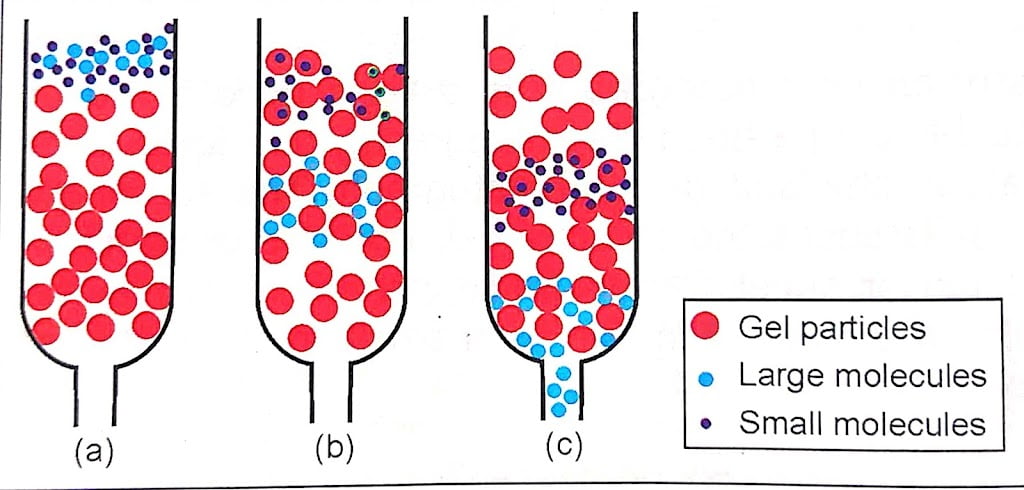
Size exclusion chromatography separates molecules in a sample based on their size or hydrodynamic volume rather than their chemical properties. It relies on the differential penetration of analyte molecules into a porous stationary phase.
Components:
Stationary Phase: Typically a porous gel matrix composed of cross-linked polymers, such as dextran, agarose, or polyacrylamide. The pores within the gel allow smaller molecules to enter while larger molecules are excluded.
Mobile Phase: A solvent or buffer solution that carries the sample through the stationary phase. The mobile phase does not interact with analytes based on their size.
Column: The stationary phase is packed into a column through which the sample is eluted, facilitating separation.
Detector: Various detectors can be used to monitor analyte elution, such as UV-Vis absorbance, refractive index, or fluorescence detectors.
Separation Mechanism: In SEC, larger molecules are excluded from the pores of the stationary phase and, therefore, travel through the column more quickly, eluting first. Smaller molecules penetrate the pores and experience a longer path through the column, eluting later. Thus, the elution order is inversely related to the size of the analyte molecules.
Applications:
Purification: Separation and purification of proteins, nucleic acids, polysaccharides, and other macromolecules.
Analysis: Determination of molecular weight distribution in polymer samples and characterization of biomolecular complexes.
Quality Control: Assessment of sample purity and determination of aggregate formation in biopharmaceuticals.
Desalting: Removal of salts and small molecules from protein samples.
Advantages:-
Non-Destructive: Analytes remain intact throughout the separation process.
High Resolution: Effective separation of molecules with small differences in size.
Versatility: Suitable for a wide range of molecules, from small proteins to large polymers.
Simplicity: Straightforward technique requiring minimal sample preparation.
Challenges:
Sample Overload: Saturation of the column with large molecules can result in poor resolution and peak broadening.
Volume Overloading: The introduction of a large sample volume can distort the separation profile.
Limited Resolution for Small Molecules: SEC is less effective for separating small molecules of similar sizes.
Size exclusion chromatography is a valuable tool in analytical and preparative chromatography, offering efficient separation of macromolecules based on their size and hydrodynamic volume. It finds widespread applications in biochemistry, biotechnology, polymer science, and pharmaceutical analysis.
Size Exclusion Chromatography